 Australian
Three Peaks Race ® .
Australian
Three Peaks Race ® . 
2008 Race Summary
by Holly Ranson
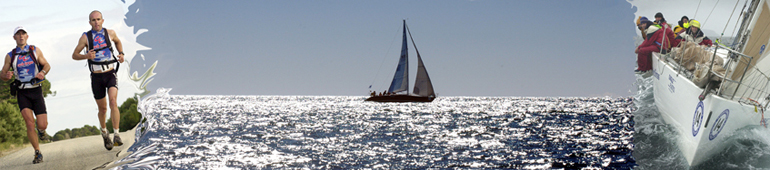
One of the world's toughest multi-sport events; the ultimate endurance challenge; a unique test of sailing skill and running stamina. The Hydro Tasmania Three Peaks Race has been described as all of this and more, but above all it is a hell of a lot of fun. The 335-nautical mile, 131-kilometre course starts at Beauty Point on the Tamar River in northern Tasmania and stops at Flinders Island in Bass Strait, Coles Bay on Tasmania's east coast and the State's capital, Hobart.
Twenty-eight entries and the successful trial of a new Google Earth yacht tracker helped raise the profile of the event. The race started in similar fashion to its 19 predecessors - on a clear, sunny Good Friday with a light but strengthening northerly sea-breeze. The ebb tide called for a conservative start with most boats hanging well back at the boat end of the line.
Forty-six foot monohull Haphazard, skippered by Three Peaks veteran Nick Edmunds, took pole position on the start line and picked the first shift to sail into stronger breeze. A good tactical sail up the river's narrow channel saw Hobart skipper Jeff Cordell in Underwater Video Systems-Host Plus overtake the bigger boat. But 9m Chamberlin catamaran Shearwater Pure Sprouts, skippered by defending champion Phillip Marshall, pushed Cordell's Mumm 36 all the way to the finish line of the sprint to Low Head. Marshall, who has won the race every year since 2005, showed he was serious about adding a fourth consecutive title to his name, moving into Bass Strait first and establishing a firm lead. The multihulls took off in ideal 15-knot reaching conditions, making a break on the bulk of the fleet early in the 90-nautical mile leg to Flinders Island. The Chamberlin 11.4m catamaran Westbury-Mersey Pharmacy, skippered by Devonport pharmacist and four-time race winner Terry Travers, showed that she would be the boat to push Marshall around the course as she ground down the smaller cat's lead in the dying breeze.
The sea-breeze dropped out altogether in the early evening and at the 10pm sked the entire fleet was within a few nautical miles, fighting for breeze off Bridport on Tasmania's north-east coast. It was slow going during the night and many of the racing division yachts made use of their alternate propulsion including oars and pedal power. The frustrating sailing leg saw the race's first retirement, cruising division catamaran 2XS, which used all of its motoring allowance before abandoning the race. Fully-crewed entry Apollonius, a self-designed and built 12 m monohull owned by Launceston sailor Julian Robinson, made a clever yet contentious move by sailing south of Anderson and Tin Kettle Islands in Franklin Sound. The Sound is the body of water between Flinders Island and Cape Barren Island, two of the largest islands in Bass Strait's Furneaux group. A protest against the course was later dismissed by the protest committee. Apollonius entered Lady Barron port, the race's first stopover, from the east of Little Green Island just as Shearwater Pure Sprouts sailed in from the west, making for an interesting two-boat battle until the monohull's crew wine-glassed a spinnaker and the catamaran slipped in just ahead. Both were beaten to the berth by cruising division entrant Aphrodite, a Victorian Beneteau, which used its motoring allowance to steam in during the port's early-morning glassy conditions.
Aphrodite's Israeli running team, Alon Peled and Ron Shilon, became the first people to have competed in the British Three Peaks Race, Scottish Islands Peaks Race and Australian Three Peaks Race when they set off on the 65-kilometre Mt Strzelecki run just before 11am.
While they took a leisurely nine and-a-half-hours on the course, Shearwater Pure Sprout's elite athletes Mark Guy and Paul McKenzie were ecstatic to break the six-hour mark, clocking in at five hours, 56 minutes to get the catamaran away in first place. The Westbury-Mersey Pharmacy team of Andrew Kromar and Michael Wheatley was hot on their heels, posting the second-fastest run of six hours flat. Meanwhile, the wharf at Lady Barron was a hive of activity with about half the fleet arriving within half an hour. This saw plenty of close, tactical sailing and daring manoeuvres on the water as the yachts fought for a second's advantage. Corelink Creative inTension used an audacious spinnaker drop about two metres from the wharf to snare 13th spot ahead of Jailhouse Grill. Several running teams struggled on the hot, dry course, but it was the challenges that brought out the best of the competitors' sportsmanship and spirit.
Modern Living Carpet Court's Nathan Fellows and Steven Jaffray put aside their own race to help Apollonius' Sally Atkinson, who fell ill with dehydration and fatigue on the mountain. For their efforts the runners received the race's Extra Mile trophy.
The overall positions of the yachts changed dramatically as the gruelling run unfolded. New Mark Pescott 11.4 catamaran Jailhouse Grill departed Lady Barron in third place after arriving 14th and sailed well out to sea on the run down the east coast of Tasmania, passing the race leaders.
But light, fickle conditions on Sunday morning had many of the yachts wallowing in windless holes with their oars out and positions changed again. It was Marshall and his Shearwater Pure Sprouts team whose blue and yellow spinnaker appeared first through Schouten Passage, south of the Freycinet Peninsula, on another stunning yet almost windless Tasmanian autumn day. The sea-breeze started to fill in from the north as the leading boats sailed into Coles Bay, giving them a good beat to the jetty. McKenzie and Guy, of Shearwater Pure Sprouts, began the -kilometre leg at . 6pm, followed 40 minutes later by their Jailhouse Grill counterparts Tim Piper and Mark Padgett. Westbury-Mersey Pharmacy was third in, an hour behind Jailhouse Grill. BWR Multihulls, which had rowed its way into fourth place during the night, was trailing by another hour.
The Strzelecki run had left many of the designated athletes weak and forced several retirements, putting Brierley Hose and Handling - which had been running seventh - out of the race and leaving fully-crewed entries Bartercard and Apollonius to send sailors up the two remaining mountains.
Due to lack of space at the jetty all yachts not immediately expecting runners were forced to anchor out in the bay. This caused problems in the early morning when the crew of Dufour 40 Team MicroHeat Bosch remained at anchor and fast asleep when their runners returned to the jetty, wasting up to half an hour of precious race time.
However, the water had turned to glass in Coles Bay and the navigation lights of the bulk of the fleet were still visible hours later. Most had not made it past Schouten Island by daybreak. The top four boats left Coles Bay in the same order that they had arrived, but a near-record run by the Shearwater Pure Sprouts team saw them extend their lead to almost an hour and-a-half. Third-placed Westbury-Mersey Pharmacy headed back out to sea more than two hours after the leaders but continually found breeze on the 100-nautical mile passage to Hobart and was able to catch up to its rivals. By the time the three catamarans - all owned and skippered by north-west Tasmanians - arrived in the Derwent River on Monday afternoon, they were separated by less than 20 boat-lengths. In one of the closest sailing leg finishes the Three Peaks Race has seen, they rowed and sailed their way up the river boat-for-boat in a five-knot south-easterly.
Westbury-Mersey Pharmacy, flying an asymmetric kite, passed to windward of the others, who were using reaching jibs and oars. Looking for clear air, Jailhouse Grill skipper Don Kidd made a make-or-break gybe to head for the centre of the river. Shearwater Pure Sprouts made a similar move and the two collected a few extra knots and looked like they would make it to the line in first and second. However, Westbury-Mersey's Terry Travers took his boat almost abeam of Hobart's iconic Wrest Point Casino and then gybed, found a better angle of sail and managed to cut inside the other two boats to finish first. Once reaching the on-water finish line, boats are permitted to motor into the wharf, but the sailing time does not stop until the runners check in at race control. So it was a mad dash to the runner drop-off point at Constitution Dock, with all three boats making a vocal and dramatic entrance. Westbury-Mersey Pharmacy powered in at a rate of knots, couldn't find reverse and smashed the port bow into the dock, nearly throwing Kromar and Wheatley into a celebratory crowd of supporters. Ecstatic skipper Travers was too elated to care about the damage and was busy congratulating his crew when Jailhouse Grill, unable to find room at the dock to let its runners off, began hailing angrily. Shearwater Pure Sprouts made a smoother bow-to entrance, with McKenzie and Guy fighting their way through media and supporters to race control. Westbury-Mersey Pharmacy's Kromar and Wheatley stopped the clock 1 seconds before McKenzie and Guy arrived and 64 seconds ahead of Piper and Padgett. In the five minutes dead time given to all runners while their survival gear and emergency rations were checked, McKenzie and Guy reminded the crowd that they did not intend to suffer the same fate as they had in the 2004 race, when Travers' crew beat them over the line by one minute and 6 seconds.
They made good on that promise early, dodging traffic to cross the road and close the gap to their competitors. By the top of Davey St they had run down Kromar and Wheatley and by the Fingerpost Track turnoff to Kunanyi/Mt Wellington had extended their lead to more than five minutes. McKenzie and Guy crossed the race's official finish line outside Hobart race control at 6.48pm, giving them an elapsed run time of two hours, 7 minutes and 9 seconds - just 9 seconds outside the record set by Kromar and Nigel Aylott in 2003 . The run secured the two the King of the Mountain trophy and a fourth consecutive race win for Marshall. Kromar and Wheatley finished ten minutes later to take second in the main racing division for Westbury-Mersey Pharmacy. Jailhouse Grill runner Padgett struggled over Kunanyi/Mt Wellington with an injury, but he and Piper still posted a good run time and got the boat home in third. Gerard Sormann's Aphrodite was the fourth boat to arrive in Hobart at 8.12 pm on Easter Monday. Shilon and Peled finished just before 1am the next morning, snaring first place in the cruising division for the Beneteau. BWR Multihulls and Plan Four also finished in the small hours of Tuesday morning, making the main racing division's first five finishers catamarans. Farr 11.6 Elphinstone Weigh To Go was the first monohull to sail into Hobart, arriving at 2.13 am; however, it was not the first to finish, with runners from Adelie and Haphazard overtaking its runners on the mountain. Mt Wellington threw up a wet and windy squall in the dead of night, lowering visibility and temperatures to challenge runners. Adelie's Iain and Simon Law ran under three hours to pick up two spots and claim the title of first racing monohull to finish.
Just after 6am, Haphazard grabbed fully-crewed division honours from David Rees' Corelink Creative inTension, which finished at 6.25am, and third-placed Pisces at 6.52am. This was a fitting tribute for a team that can boast more than 80 previous races between them. Skipper Edmunds and crew-member David Wright are the only two competitors to have participated in all 20 Three Peaks Races, while the monohull holds the record for the most races for a yacht.
Rounding out the cruising division placegetters were Sam Ibott's Team Windsong and Richard Gardner's Stornoway. The arrival of Epsilon runners Michael Lovric and Neil Hawthorne at Hobart race control at 3.47pm on Tuesday drew the curtain on the 20th Hydro Tasmania Three Peaks Race.
The New South Welshmen were the last competitors to cross the Constitution Dock finish line, more than 24 hours after the race winners arrived in Hobart. Of the race's 28 entries - the biggest fleet since 1989's inaugural race - 23 finished, four retired and one was withdrawn before the start.


Leg 2 Partner


